

Watches sold at an approachable scale tend to collect a lot of folklore, and much of it does not survive a look at the actual catalog. Several Swatch watch myths debunked below cover construction, coverage expectations, and the Swiss identity behind the brand. Checking real collections and listed specifications clears up most of the confusion once specific product lines replace vague assumptions.
The Plastic Case Misconception: Understanding Swatch’s Material Strategy
The most repeated claim is that every watch from Swatch uses the same basic plastic case. That claim does not hold up once the current catalog is examined closely. The brand mixes case materials across its lines, and each collection carries its own combination of finish, color, and shape.
Plastic does appear in several collections, often in bright, saturated colors paired with bold graphic prints. Art-inspired releases, including pieces referencing Pollock or Monet, use lighter cases so the printed design stays the visual focus. That variety alone breaks the idea of one uniform material running through the whole range.
SKIN, IRONY, and BIG BOLD Watch Lines: Debunking the ‘All Plastic’ Myth
Swatch organizes much of its range into distinct collections, and the lineup includes different silhouettes and band types rather than one uniform shape. Band materials vary between textile and non-textile options, which pushes back on the idea of a single construction method across every model. This is one of the clearer Swatch watch myths debunked simply by comparing band specifications side by side.
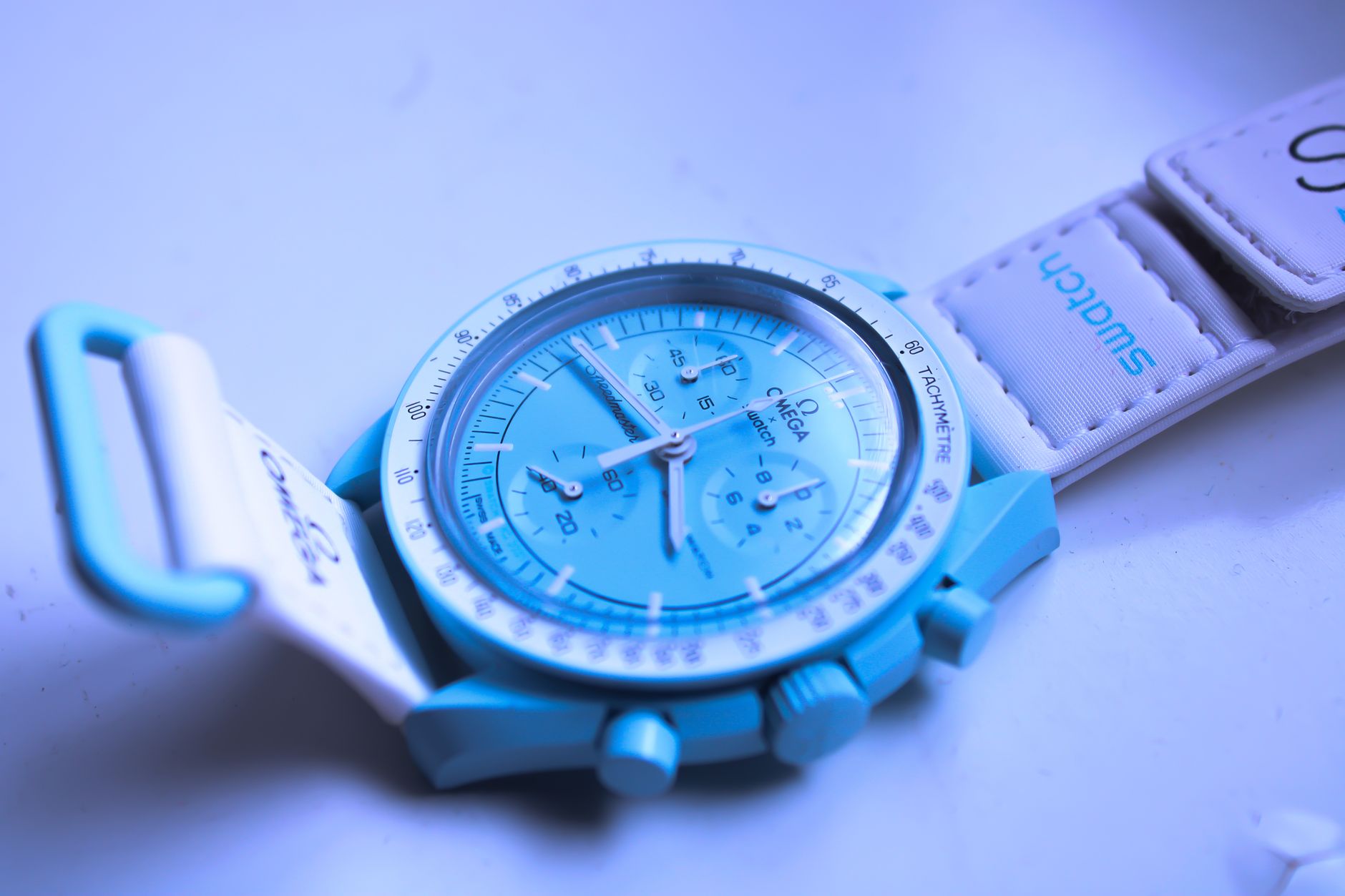
The Moonswatch collection, offered in multiple mission-themed variants including Mission on Earth, Mission to the Sun, Mission to the Moon, and Mission to Mars, shows how one release carries distinct colorways while sharing a design language. The Scuba Fifty Fathoms pieces, available in Atlantic Ocean, Pacific Ocean, and Indian Ocean variants, extend that same idea into a diving-oriented design. None of this fits a narrative where every model is interchangeable molded plastic.
Why Swiss-Made Doesn’t Mean Expensive: Swatch’s Design Philosophy
Another persistent myth treats Swiss manufacturing and broad accessibility as mutually exclusive ideas. Swatch built its identity around making Swiss-associated watchmaking available without demanding a luxury-level commitment. As a result, the catalog spans everyday pieces, kids’ watches, and more specialized diving or mission-themed models side by side.
That positioning shows up clearly in the Flik Flak children’s range, which includes space-themed and sport-themed watches organized around topics such as adventure, animals, and football or basketball. These watches match interests that range from outer space to ballet and bikes. The space-themed line alone lists more than a dozen individual watches, which points to a dedicated range rather than a minor side offering.
The Two-Year Warranty Myth: What Swatch Actually Guarantees
Coverage confusion is common across the watch category in general, and assumptions about guarantees often get repeated without checking the specifics tied to a given purchase. Swatch does not list one single blanket warranty figure that applies across every collection in the available brand information. That gap matters because assuming a fixed number across children’s watches, diving pieces, and mission-themed collaborations is not something the available information supports.
A more reliable approach is checking the listed details tied to the specific collection in question rather than repeating a figure picked up elsewhere online. Debunking watch myths around warranty coverage mostly means resisting the urge to fill a gap with assumption. For now, coverage specifics should be confirmed collection by collection rather than treated as uniform.
Material Variety in Current Collections
The idea that Swatch sells nothing but molded plastic also overlooks how varied current collections are in color, finish, and material choice. Bestseller and new-arrival pieces listed on the brand’s own site span a wide range of finishes, from glossy bright tones to more muted, metallic-looking options. This spread in finish alone points to a broader set of material choices than a single-plastic narrative allows.
New arrivals and bestseller rotations bring fresh colorways and themes on a rolling basis, which keeps the catalog changing rather than static. Chrono-style pieces sit alongside simpler dial designs, and personalized options such as custom sport watches add another layer of variety. That pattern of rotation undercuts the notion that the range offers only one unchanging type of watch.
- The belief that every watch uses identical plastic ignores the brand’s varied band materials, which include both textile and non-textile options.
- The assumption that Swiss-associated watchmaking must come at a high cost overlooks how everyday and children’s collections sit side by side in the catalog.
- The idea that warranty terms are identical across every model does not hold up once the variety of collections, from diving pieces to kids’ watches, is considered.
- The notion that the range targets only one age group is contradicted by dedicated Flik Flak lines built around space and sport themes for younger wearers.
- The claim that designs never change is undercut by frequent new arrivals and rotating bestseller lists.
Separating Assumption From Specification
Treating each Swatch collection on its own listed terms rather than inherited rumor reveals what the brand actually offers across its range.